Pietrasanta is a small town at the foot of the Apuan Alps, ten minutes inland from Forte dei Marmi and twenty-five minutes south of the Carrara quarries. Population around 23,000. Working sculptors — plus the artisans, foundrymen, pointing-machine operators, mould-makers and patinators who keep them employed — number in the hundreds. A ratio almost certainly unique in Europe.
Not a museum town. Marble dust still settles on the cars.
Why Pietrasanta specifically
Geography first. Apuan Alps rising directly behind the town hold the densest concentration of high-quality marble in the world — Carrara is the loudest name, but the same formation runs south through Seravezza and the Altissimo face Michelangelo walked in 1518 hunting stone for San Lorenzo. Any block cut in the mountains above can be on a studio floor within an hour.
Marble trade here is medieval. What makes the modern scene distinctive is the twentieth-century layer laid on top. Beginning in the 1950s, a handful of foundries and ateliers — Henraux, Fonderia Massimo Del Chiaro, Fonderia Artistica Versiliese — took on commissions from international sculptors who had the vision but not the hands for large stone or bronze. Henry Moore kept a long working relationship with Henraux in Querceta and with artisans in town; Fernando Botero lived here for decades and finished most of his monumental bronzes locally. Igor Mitoraj worked in Pietrasanta from 1983 until his death; retrospectives still fill the Piazza del Duomo with his fragmentary heads and torsos. Jean Arp worked with Henraux late in life.
Names are not the point. Infrastructure is. A sculptor arriving today can find, within walking distance, a marble yard willing to sell a block of Statuario, a foundry to cast and patinate a bronze, a studio to carry out pointing from a plaster maquette, and a shipping agent who has done nothing else for a quarter-century. Nowhere else in the West offers that chain under one postcode.
Pietrasanta is the one Italian town where the word laboratorio still means what it says: a place where work is being done, usually loudly, usually by someone with a dust-masked face and a grinder in hand.
What a studio visit actually looks like
Calibrate expectations. Not the Louvre. A studio visit is a short, informal walk-through of a working space — ten to twenty minutes, rarely guided in English, occasionally interrupted by the arrival of a truck. No gift shop. No ticket.
What visitors will generally find:
- A yard stacked with blocks, offcuts, and work-in-progress pieces under tarps.
- An interior hall, white with dust, two to six artisans at work — pointing, cutting, polishing.
- A pointing machine (the pantograph that transfers measurements from maquette to block).
- Finished pieces awaiting shipping in a corner or adjoining room.
- A small office, a coffee machine, and someone in their fifties who knows everything.
Etiquette is unwritten but consistent. Greet on arrival. Ask before photographing. Do not touch. Do not linger beside running machinery. If the owner talks, ask about the piece in progress, not the celebrity who commissioned it — artisans are proud of their craft and bored by name-dropping.
Which studios take walk-ins
The list below reflects spring 2026 and should be verified locally. Several studios close in August when the owners do.
| Studio or space | Type | Walk-in policy | Notes |
|---|---|---|---|
| Sant'Agostino (former church) | Main exhibition space | Yes, during shows | Run by the comune; free or low-ticket; shows rotate every 4–8 weeks |
| Fonderia Massimo Del Chiaro | Bronze foundry (Via delle Iare) | By appointment | Email a week ahead; working foundry, not a museum |
| Fonderia Artistica Versiliese | Bronze foundry | By appointment | Similar protocol; English spoken |
| Studio SEM | Marble-carving studio, courses | Walk-ins welcome for enquiries | Runs residential marble courses; worth a visit even if not enrolling |
| Various ateliers, centro storico | Working studios (mixed) | Open door during working hours | Via Barsanti, Via Stagio Stagi, Via del Marzocco — walk and look |
Best first-visit strategy: walk the three or four streets west of the Piazza del Duomo — Via Barsanti and its side streets especially — between 10 a.m. and noon on a weekday. Several ateliers leave roll-up doors open to the street. Some wave visitors in; some do not. Slow down and look interested without pretending to buy.
The piazza in summer
Piazza del Duomo is the free, un-ticketed core of the scene. From mid-June through early September the town stages outdoor sculpture shows in and around it — Mitoraj retrospectives recur, but programming rotates, and in any given year a dozen monumental works may stand in the flagged square under the cathedral's unfinished marble façade. The comune publishes the summer programme. Sant'Agostino, the former church on the south side, is the main civic exhibition hall.
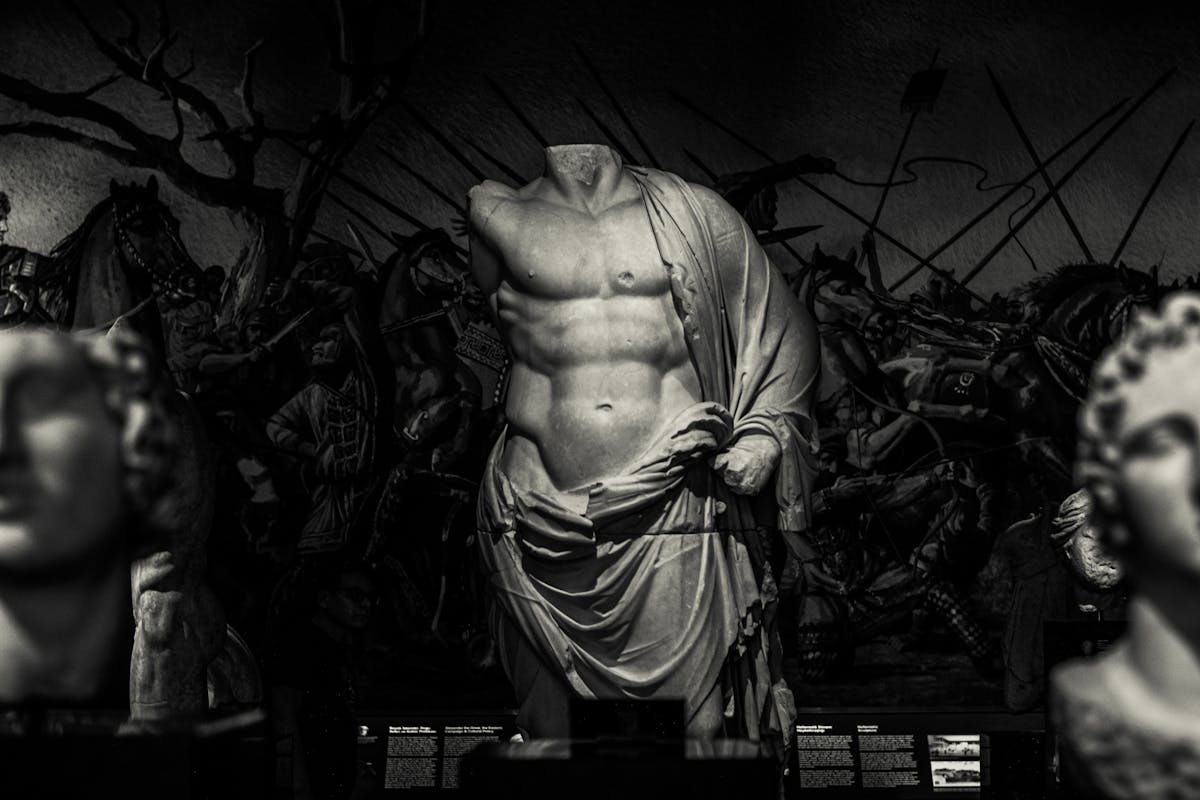
Evening hours matter. In July and August the shows stay lit until around 11 p.m., the arcade cafés stay open in parallel, and the piazza fills with residents, gallerists, and the odd touring sculptor. It is the single best hour in the Versilia calendar for a non-specialist to grasp what the town is.
Practical notes
- Getting there. Pietrasanta has a station on the Pisa–Genoa regional line, five minutes north of Viareggio by train. Fifteen-minute flat walk from there to the Piazza del Duomo along Via Mazzini.
- When to come. May, June and September: studios open, no August closures. Avoid the second and third weeks of August, when much of Italy shuts and several studios do too.
- What to wear. Closed shoes in any working studio — marble chips do not respect sandals. Evening dress code in the piazza is Tuscan-casual; a linen shirt will outperform a logo T-shirt socially.
- Eating. Cafés on the piazza are adequate but tourist-priced. Better trattorie are one street back — Via Stagio Stagi and Via Mazzini. Fried anchovies, tordelli, and focaccia from the ovens in Via del Marzocco are the regional notes.
- Shopping. Smaller ateliers sell finished small-scale pieces and offcuts — a marble mortar or palm-sized abstract runs €80–€400. Larger commissions are a separate universe.
Pietrasanta rewards a day — not an hour between lunch and the train. Reasonable plan: train in at 10, walk to the piazza, one indoor show at Sant'Agostino, a loop of Via Barsanti's ateliers, lunch off the square, a pre-booked studio or foundry visit in the afternoon. Dinner and the open-air piazza after sunset; the 22:00-ish regional back to Viareggio. See also our entries on The Carrara Marble Quarries, which supply most of what Pietrasanta turns; La Versiliana Literary Festival, which runs in Marina di Pietrasanta during the same weeks as the summer sculpture shows; and Cittadella del Carnevale, the papier-mâché counterpart twenty minutes down the coast. Third-party background is summarised by Lonely Planet's Tuscany coverage.