Between the mouth of the Fiumetto and the northernmost marina of Forte dei Marmi, five kilometres of sand are divided into somewhere between a hundred and a hundred and ten separately concessioned bathing establishments — what Italians call stabilimenti balneari and what everyone on holiday learns to call, with varying degrees of affection, the bagni. Each has a painted gate, a numbered frontage, its own colour-scheme of umbrellas, and its own price list. Very little of that list is posted at the road.
This is the first thing to understand. Forte's coast is not a beach in the English sense. It is a tenanted colonnade of private concessions laid over a public shoreline, and the fare you pay is the fare to cross the threshold.
What the beach clubs actually sell
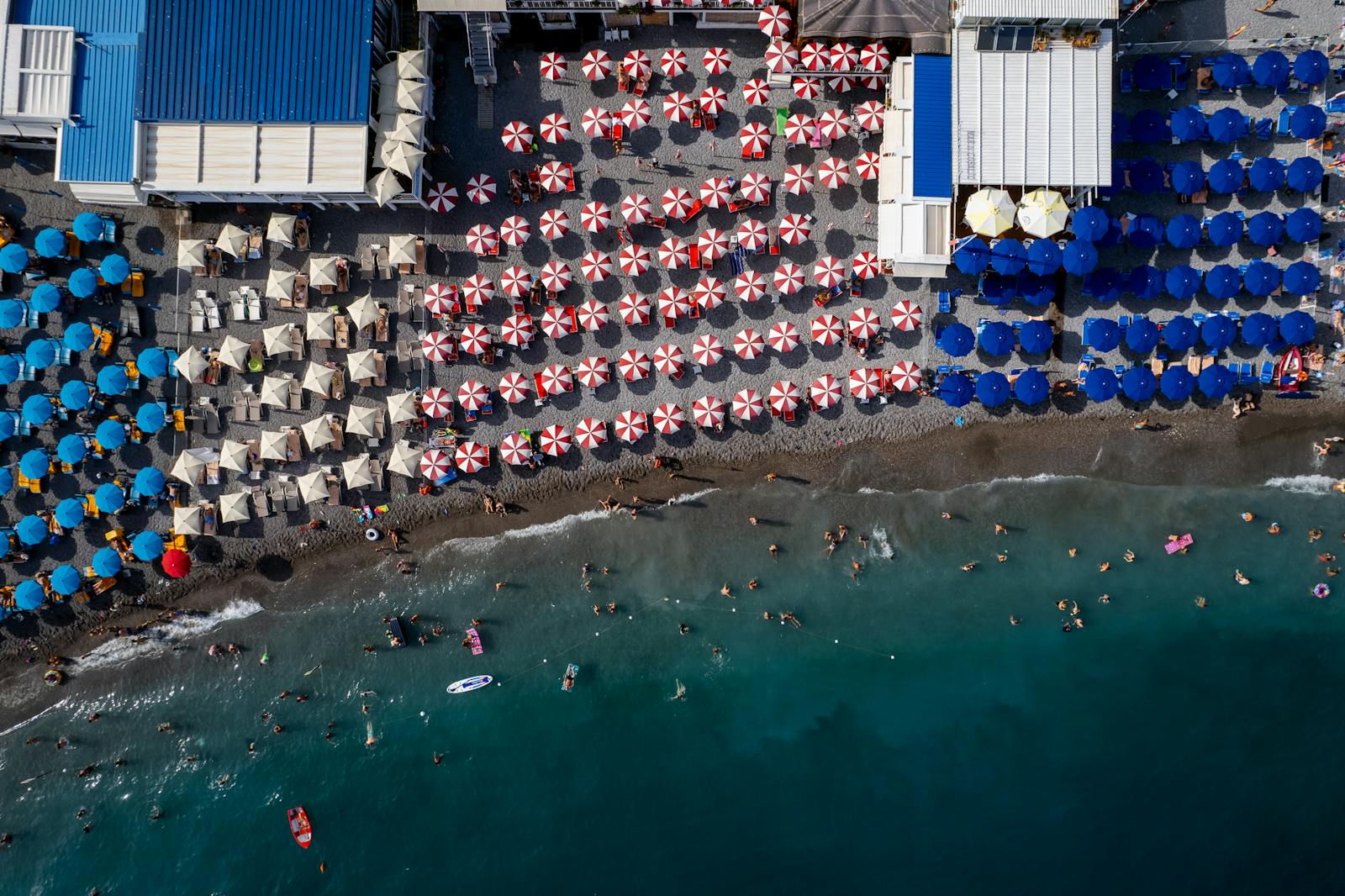
A unit of sale is the ombrellone: one umbrella, two loungers (lettini), usually a third chair, and access to showers, changing cabins, bar and bathrooms for the day. A daily fare at a mid-tier Forte club runs €60 to €90 in July. A front-row umbrella — first line off the water — is priced separately, and the mark-up over the back rows is unashamed: usually thirty to sixty per cent.
Wooden cabanas (cabine) are a separate rental. Think of them as private changing rooms with a lock and a bench, rented by the week or month rather than the day. They are what give Forte its picture-postcard geometry; at the older clubs, the names painted on the doors have not changed since before the war.
The stabilimento tradition
Italy's bathing-club model is older than most of the people defending it. First Versilia stabilimenti opened in the late nineteenth century as health-cure concerns for the Florentine and Milanese bourgeoisie; by the 1920s, the stretch from Viareggio north to Forte was already a patchwork of private concessions on state-owned beachfront. Legal arrangements have barely moved since. Italy owns the seabed and the sand; concessions to put a row of umbrellas on it are auctioned (or, more often, renewed with very little drama) to private operators, usually families, usually for decades at a time.
Older Forte clubs are therefore family businesses in a real sense. A name on the gate is a grandfather's name. Whoever takes your booking at Bagno Piero is probably a granddaughter. Whatever you think of the model economically — and it has been litigated, most recently under the EU's Bolkestein directive, to no great effect — operational culture is one of inherited fussiness: cabanas repainted on a specific week in April, sand raked in a specific direction, regulars seated on specific umbrellas that are not, strictly speaking, reservable by the public.
Four clubs worth the fare
We list the clubs by what they actually are, not by who photographs them. Prices are April 2026; all figures are for two loungers, one umbrella, one weekday in July, seconda fila unless noted.
| Club | Price range | Vibe | Verdict |
|---|---|---|---|
| Bagno Piero | €70–€110 | Old Forte, regulars, wooden cabanas painted white and green | The reference. Book two weeks out. |
| Bagno Roma Levante | €60–€95 | Family-run, low ceremony, good lunch at the ristorantino | Best weekday value on the Forte side of the Fiumetto. |
| Bagno Alpemare | €120–€260 | Polished, Bocelli-family association, very good kitchen | Expensive but earns it at lunch. Book for the table, not the umbrella. |
| Twiga Beach Club | €150–€300+ | Flavio Briatore's operation; photo-oriented crowd, bottle-service culture | Sold as a status object. Priced accordingly. Not a swim. |
Bagno Piero is the editorial pick, and — on a Saturday in August — the hardest of the four to walk into without a booking. It still operates as a club rather than a performance of one: regulars from Milan and Lugano have the same umbrella every summer for three generations, the kitchen sends out a decent grilled orata for under €30, and staff indifference to your phone is a feature. Walkable from the central piazza.
Bagno Roma Levante is where we send readers who do not want to think too hard. Not cheap by the standards of a public Dutch beach; certainly cheap by the standards of its neighbours. Walk-ins seated on weekdays without fuss. An onsite ristorantino, modestly priced and honestly Tuscan — cacciucco off-menu if you ask — and sand groomed to the same standard as Twiga's at half the fare.
Bagno Alpemare, associated with the Bocelli family, sits further down the coast toward Fiumetto. Family involvement is real — since the club's relaunch in the mid-2010s — but ownership is not the reason to go. A genuinely good restaurant (Slow Food recognition or equivalent in recent years), service warmer than the price tag suggests, umbrella fare stiff. Reserve for lunch if you can and treat the beach as an accessory.
Twiga exists. We note this rather than recommend it. Flavio Briatore's operation north of the Fiumetto is a working restaurant-and-club with a specific clientele: Instagrammed, bottle-serviced, Eurodance-soundtracked. Food is competent and overpriced; bathing is secondary to theatre. If that is what you want, go for it; do not confuse it with a swim.
What to skip and why
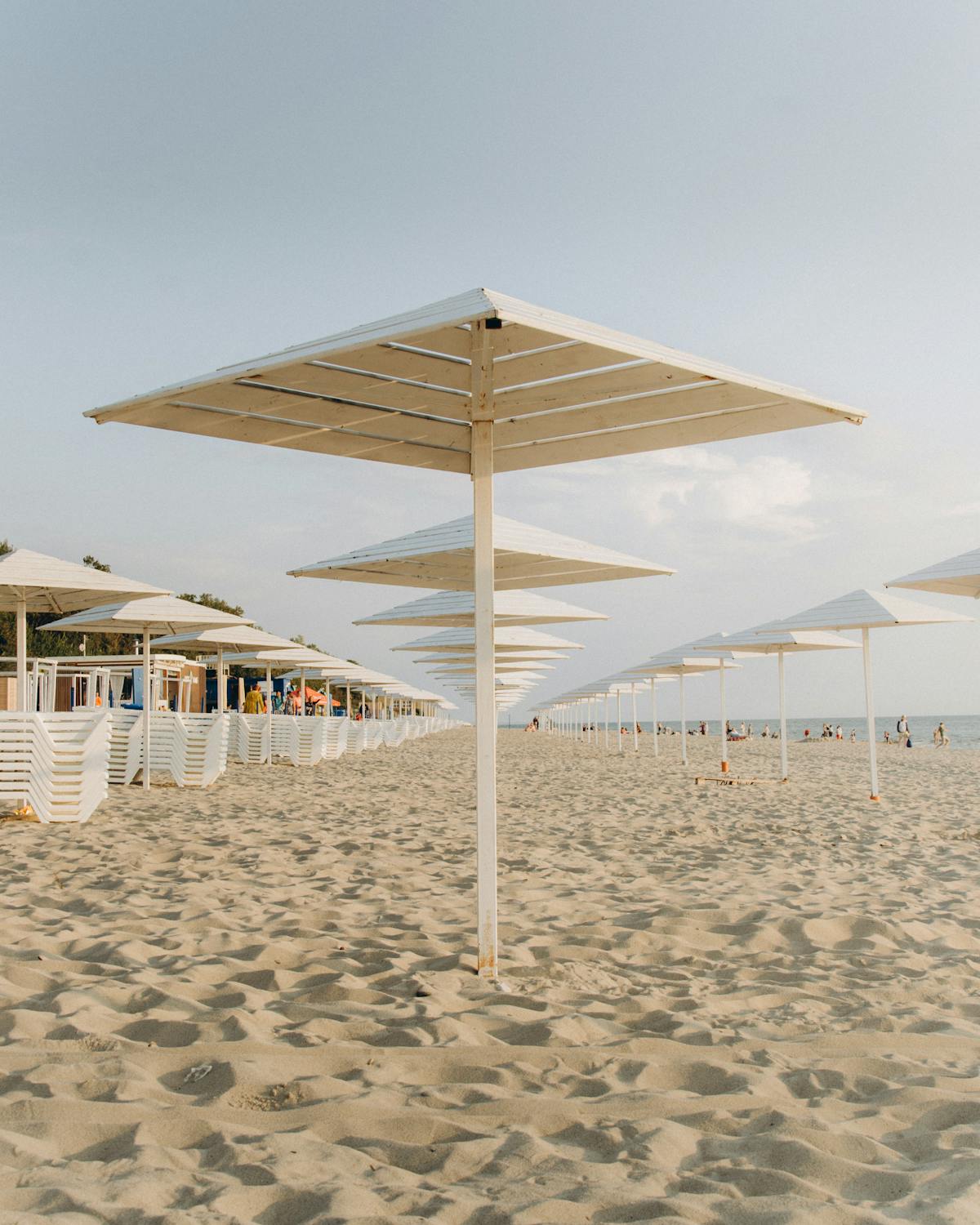
Forte dei Marmi is stricter on public-beach access than Viareggio, Marina di Pietrasanta or Marina di Torre del Lago. Spiaggia libera in the commune proper amounts to a few short ribbons of sand between concessions — one patch near the Pontile, a second further north toward the Marina di Ronchi boundary, a third near the Fiumetto mouth. Usable but crowded on weekends, with no amenities, policed for umbrellas and furniture by the capitaneria. If the point of coming to Forte is a cheap day on the sand, this is not the right commune. Consider Marina di Torre del Lago instead: flatter, scrubbier, and with serious stretches of public beach.
A club that will not quote the daily fare over the phone is a club priced by who is asking. Hang up. There are ninety-eight others.
Two other footnotes on clubs to avoid. Any establishment advertising exclusively via a celebrity-heavy Instagram feed is priced for the feed, not the visitor. Any bagno insisting on a minimum restaurant spend in exchange for the umbrella — which happens more than it should at the glossier end — is best declined on principle.
The economics of a sunbed
A back-of-envelope calculation is clarifying. A first-line umbrella at a mid-tier Forte club, booked for the full July–August season, rents for around €6,500–€9,000. At €150 a day for the nine peak weeks, that is breakeven. Most seasonal tenants do not calculate it this way: the cabana comes with it, and the cabana is the status object. A locked wooden door with a painted name signals that a family has been coming here since Agnelli times. A lounger does not.
- Day-of walk-in is almost always possible in May, early June and late September. It is almost never possible in the first fortnight of August, which is when Italian domestic holidays concentrate.
- Cash or card. The older bagni now take cards, but several of the best still discount five to ten per cent for cash. Ask.
- Tipping is not expected for the umbrella attendant but welcomed for the restaurant staff, modest (€2–€5 per cover).
- Dogs. Allowed at some clubs (Alpemare among them), forbidden at most. Confirm before booking.
Further reading: municipal tourist information at visitfortedeimarmi.it keeps a serviceable list of concessioned clubs, though without rankings; Lonely Planet's Versilia pages remain readable for a broader take; aggregate reviews on Tripadvisor are useful mainly as a sanity check on prices.
For the last Liberty-era pavilion on the Versilia that still takes day guests, see Bagno Balena, Viareggio. For a seafood-driven morning that pairs cleanly with a Forte afternoon, see The Forte dei Marmi Fish Market & Where to Eat It. For the cheaper, looser alternative down the coast, see Marina di Torre del Lago.