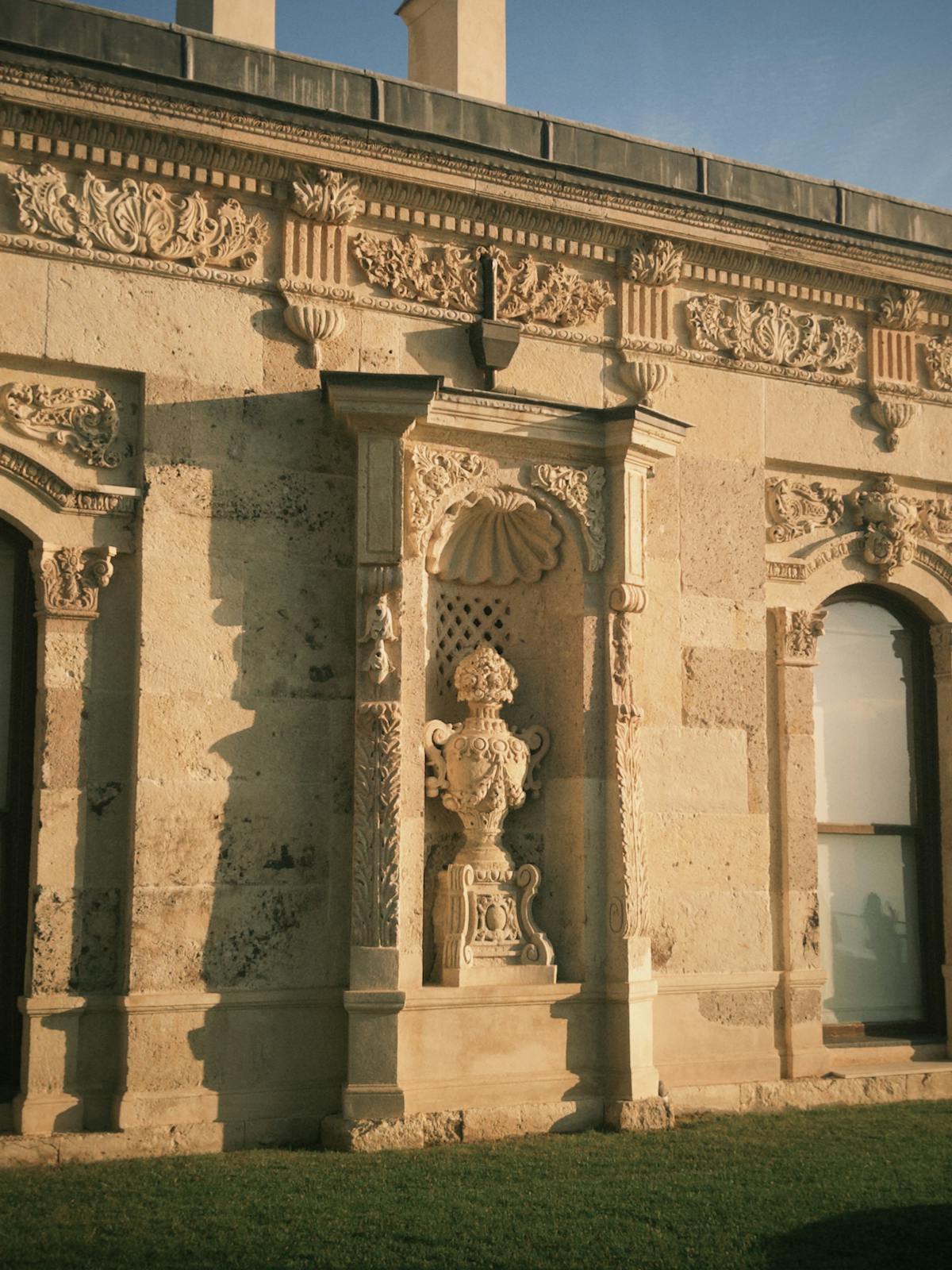
If a single frame has to stand for Viareggio, it is usually this one: two squat onion-domed towers rising off the seafront promenade, ceramic tile running the parapet, a pair of copper-capped kiosks anchoring each end. The Gran Caffè Margherita is the postcard. It is also, in strict architectural terms, not quite the building most visitors think they are looking at — what survives is a 1929 reworking by Galileo Chini of an older pavilion, stitched together after a fire and stretched with decorative ambition the original never had.
The Building in One Paragraph
A low, wide, two-storey pavilion sat end-on to the sea, with arcaded loggias, a shallow roofline and those two disproportionate Eastern domes lifting the silhouette above its neighbours. Ceramic tile — green, ochre, a muted cobalt — runs as banding and medallion work across the upper course. Inside, when the doors are open, painted ceilings and a mirrored ballroom recall the building's first life as a caffè-concerto, the turn-of-century Italian hybrid of cafe, cabaret and dance floor.
It sits on the Passeggiata — Viale Regina Margherita — near the Piazza Puccini end of the promenade. Giacomo Puccini, who composed most of his later operas at nearby Torre del Lago, used it as a drawing room.
Galileo Chini and the 1929 Intervention
Chini is not a household name outside Italy; inside it, he is the figure who dragged Tuscan decorative arts into the twentieth century. Florentine by training, he ran a ceramics studio in the Mugello hills above Florence (the Manifattura Chini, later relocated to Borgo San Lorenzo) and spent three years at the Siamese royal court in Bangkok between 1911 and 1913, painting the throne-hall frescoes. He came back Orientalised — a word contemporary critics used approvingly — and the domes at Viareggio are the most visible consequence of that trip.
Chini's genius, if the word survives the century, was to treat a seaside cafe as seriously as a throne room. The Margherita's cornice is painted with the same care as a ducal ceiling in Prato. It reads as excess only to viewers who have not stood under it.
His 1929 renovation added the domes, re-skinned the exterior in patterned ceramic, and rebuilt the interior ballroom. Chini was then sixty-six and at the end of a long public-works career — the Margherita is, arguably, his valedictory building. He died in 1956, by which time the seafront had been repainted a dozen times and the cafe itself had already begun its long cycle of closures and reopenings.
The Walk Past Five More
From the Margherita, walking north along the Passeggiata (away from the Piazza Mazzini end), a visitor passes what is arguably the densest surviving stretch of Italian Liberty architecture anywhere on the coast. A strict walking route, in sequence:
- Bagno Balena — the only surviving Liberty-era bathing pavilion still run by the family that founded it. About 200 m north. Covered in its own Index entry.
- Magazzini Duilio 48 — a 1920s storefront by Alfredo Belluomini, originally a haberdashery, with the coloured-glass and wrought-iron shopfront still intact. Now a boutique; the facade is the attraction.
- Supercinema Savoia — slightly inland on Via San Martino, a 1938 cinema whose stepped-parapet exterior and neon lettering fall on the late-Liberty / early-Decò cusp. Still screening films.
- Villa Argentina — set back from the seafront on Via Vespucci, a 1906 private villa with exterior frescoes by Plinio Nomellini. The gardens open intermittently to the public.
- Villino Tiglio — a smaller domestic example about 400 m inland, all exposed brick and terracotta, by the architect Alfredo Belluomini who worked with Chini on several of the seafront projects.
Total distance, if walked as one loop back to the Margherita, is roughly 1.4 kilometres. An attentive hour covers it; a photographer's afternoon easily absorbs three.
A Note on Opening Hours
Since the mid-1990s, the cafe itself has been, at various points, open as a brasserie, shut for structural survey, reopened as a wedding hall, shut again, partially opened for summer-season bar service, and — at time of writing in April 2026 — shut. The municipality (Comune di Viareggio) lists the building as heritage-protected and has backed multiple tender rounds for new concessionaires; the tenders keep failing on the capital outlay required to bring the interior into compliance. Exterior views are always available; interior access is a lottery.
For a visitor who wants what the building projects — the domes, the ceramic, the sea behind — late afternoon is the moment. The glazes on the south-facing parapet catch the light for roughly an hour before sunset and the photographs taken then are the photographs everyone else has also taken, which is the point.
Why It Almost Wasn't There
Viareggio's entire seafront used to be made of wood. Not the kiosks and changing-cabins alone — the whole frontage: timber hotels, wooden arcades, plank walkways laid directly onto the sand. On the night of 18 October 1917, during a sirocco that drove flames across a mile of pine boarding, the lot of it burned. Contemporary accounts (preserved in the municipal archive and summarised on the town's Wikipedia entry) put the destruction at more than thirty buildings in a single night.
A rebuild, from 1918 onward, produced the seafront a visitor sees now: masonry and reinforced concrete faced in stucco, tile and ceramic, commissioned from the Tuscan Liberty school then in its final decade. Chini, Belluomini and their peers had the rarest of architectural gifts — a blank site, a public client, and a deadline measured in years rather than months. Chini's 1929 extension of the Margherita is the capstone. Had the 1917 fire not happened, Viareggio would today be a modest wooden resort with photographs of what used to be. Instead it is a ceramic one, and the cafe at the corner is its emblem.
Every coastal town on the Tyrrhenian has a fire story. Viareggio is the one that used the fire well.
For further Liberty-era context within the Index, the Bagno Balena entry tracks what the 1917 rebuild did to the bathing pavilions, and the Pietrasanta Marble Studios entry covers the inland counterpart — where a great deal of the carved stone ornament on the Viareggio facades was actually cut. External reading: Lonely Planet's Viareggio pages give a general orientation; the Wikipedia entry on Galileo Chini lists his wider catalogue for anyone who wants to follow his ceramic work into the Mugello.